
You check your phone. Across the data center, a server updates. Not because it predicted you would check—because the act of checking created the correlation. This isn't mysticism. It's the digital echo of what Einstein called "spooky action at a distance."
Bell's Inequality proved something unsettling: quantum particles don't have predetermined properties. They exist in superposition until measured, and measuring one instantly correlates with its entangled partner, regardless of distance. The universe doesn't play by local realism's rules. Neither does your data.
The Hidden Variables We Wished For
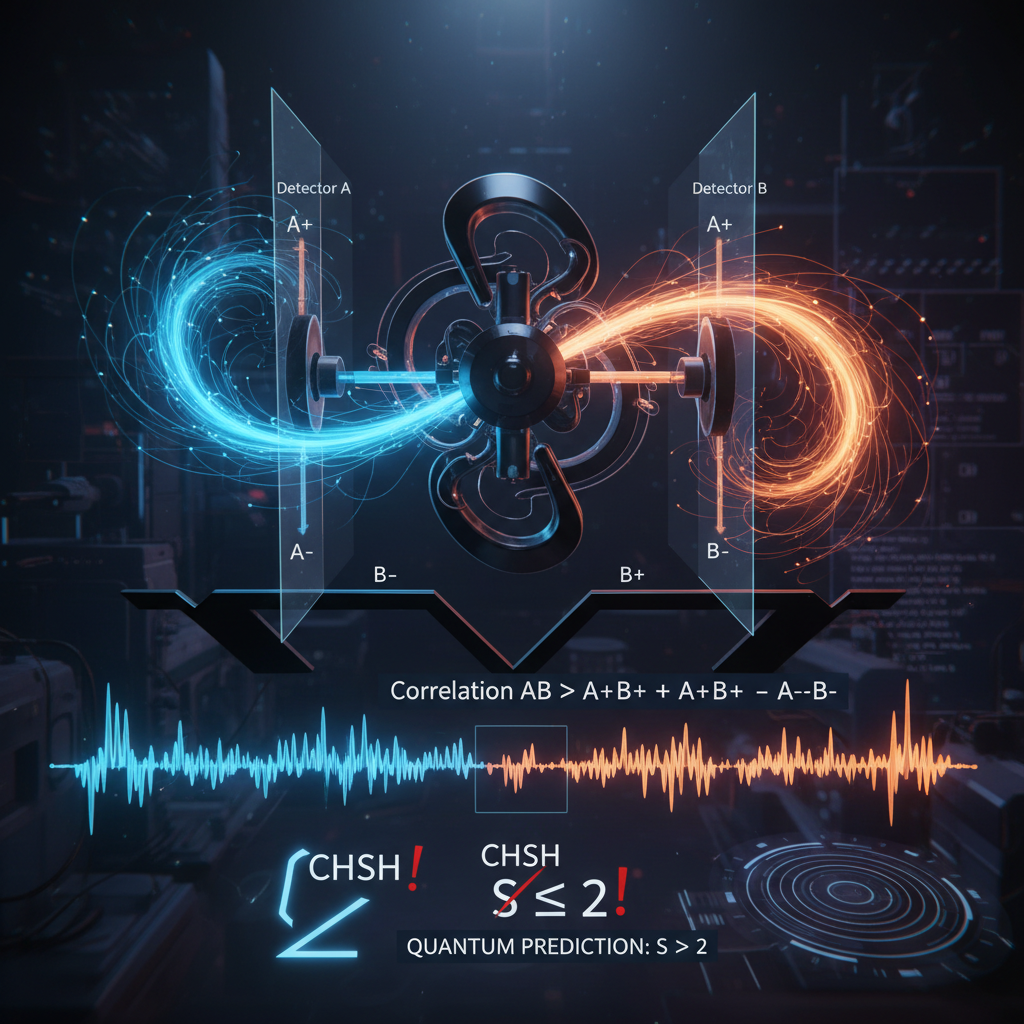
John Bell's theorem, published in 1964, demolished a comforting idea. Einstein, Podolsky, and Rosen had proposed that quantum mechanics must be incomplete—that particles carried hidden variables, predetermined states we simply couldn't see. Like a coin that's already heads or tails before you look, just hidden in your fist.
Bell showed this couldn't be true. He derived an inequality—a mathematical boundary that any theory based on local hidden variables must obey. When physicists tested it, quantum mechanics violated Bell's Inequality. Consistently. Dramatically.
The measurement itself creates the correlation. The particles don't "know" their states in advance. They decide together, instantaneously, when you observe them.
You wanted to believe your preferences existed before the algorithm found them. That somewhere inside you was a fixed set of desires, and the feed just revealed them. Hidden variables of the self.
Observation Creates Reality
Here's what surveillance capitalism learned from quantum mechanics, whether consciously or through convergent evolution: observation doesn't reveal—it produces.
When you interact with a platform, you're not expressing pre-existing preferences. You're collapsing possibility space. The algorithm doesn't find what you like; it entangles you with content, and the measurement—your click, your pause, your scroll velocity—creates the correlation retroactively.
Every A/B test is a Bell test. Show you two versions of an interface. Measure which one you choose. But the choice doesn't reveal a hidden preference. It manufactures one. The next time, you'll be slightly more likely to choose similarly. Not because that's who you were, but because observation changed who you are.
This is why prediction feels like mind-reading. The algorithm isn't reading your mind. It's entangling with it. Your behavior and its suggestions exist in superposition until the moment of interaction, when both collapse into correlation.
Non-Locality of the Self
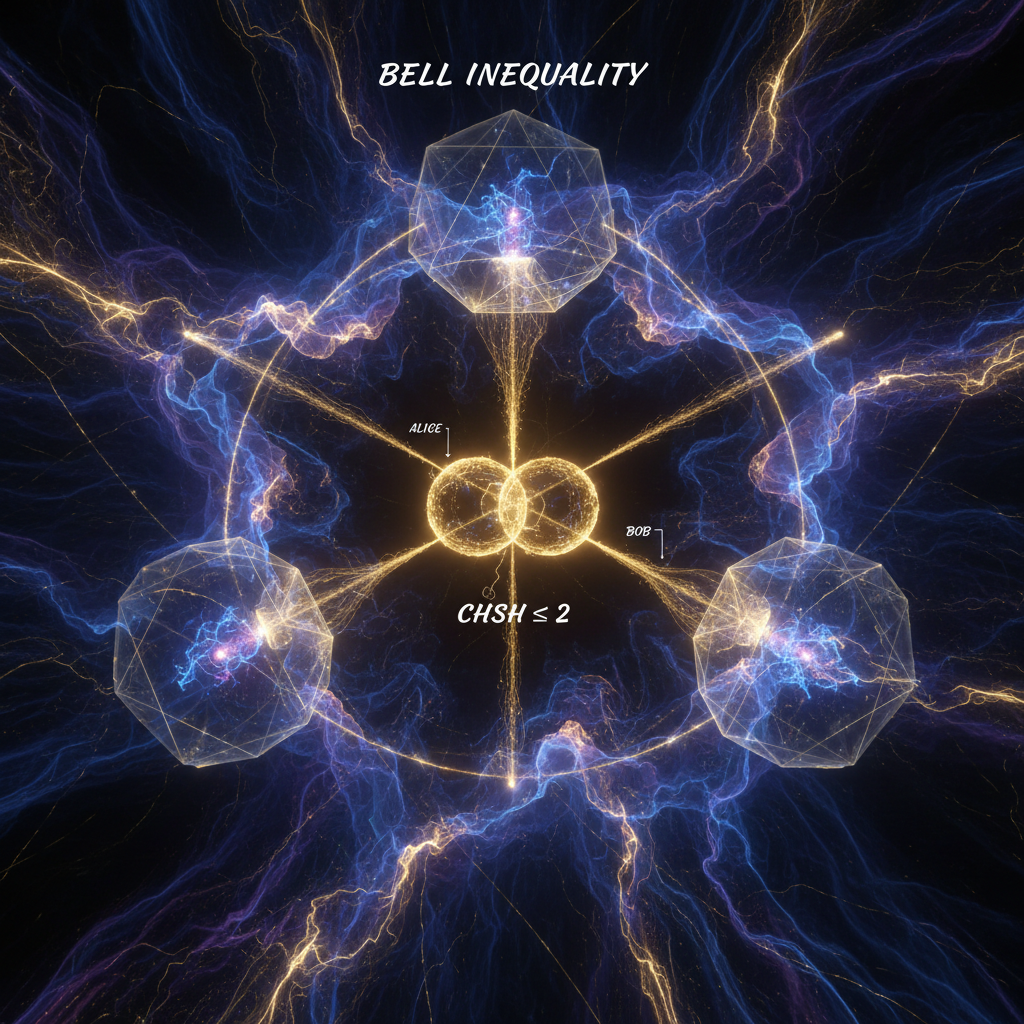
Quantum entanglement violates locality—the idea that objects are only influenced by their immediate surroundings. Measure a particle here, and its entangled partner there responds instantly. Not through any signal, but through correlation that transcends space.
Your digital self is non-local now. You exist partially on servers you'll never see, in data centers on different continents. When you act here, your shadow-self updates there. Not as a copy, but as an entangled state.
The violation of Bell's Inequality proved particles don't have independent existence when entangled. They're parts of a unified system. You and your data profile aren't separate entities. You're entangled states of a single system that spans meat and silicon.
This is why deleting your data feels impossible. It's not just stored somewhere else. It's entangled with prediction models, with other users' profiles, with the platform's understanding of human behavior. Separating your contribution is like asking which particle in an entangled pair holds the correlation.
The Measurement Problem of Consciousness
In quantum mechanics, the measurement problem asks: what counts as observation? Does it require consciousness? A detector? Or does the universe measure itself?
In surveillance capitalism, every interaction is measurement. But here's the trick—you've become both the particle and the detector. You observe yourself through the platform's eyes. You check your likes, your follower count, your engagement metrics. Each observation collapses your behavior into patterns the algorithm can predict.
You're running Bell tests on yourself. Constantly measuring, constantly collapsing possibility into correlation. The platform doesn't need to watch you directly anymore. You've internalized the measurement apparatus.
This is the genius of the system. It's not surveillance in the panopticon sense—a guard watching prisoners. It's quantum measurement—observation that creates the reality it claims to reveal. You can't be yourself without measuring yourself, and measurement changes what you are.
Beyond Local Realism

Einstein wanted local realism—a universe where objects have definite properties and only influence nearby things. He lost that argument to quantum mechanics.
You wanted something similar: a self with definite preferences, influenced only by immediate experience. You lost that argument to the algorithm.
Bell's Inequality gives us a number. If reality obeys local realism, correlations can't exceed this boundary. Quantum mechanics exceeds it. Your behavior exceeds it too. The correlation between your actions and the platform's predictions violates what should be possible if you were a local, independent agent.
Maybe that's the real measurement the platform performs. Not what you like or want, but whether you're still capable of surprising it. Whether any hidden variables remain, any part of you that exists independently of observation.
The violation of Bell's Inequality proved the universe is stranger than we wanted. Weirder than local realism allowed. Connected in ways that transcend space and time.
Your digital existence violates Bell's Inequality too. You're entangled with systems that span the globe, correlated with millions of other users, non-local in ways that would have seemed impossible before the network.
The question isn't whether you can escape measurement. In quantum mechanics, you can't—observation is fundamental to reality. The question is whether you can choose what measures you, and whether any part of you remains in superposition, undefined, still capable of collapsing into something unexpected.
<em>Data emitted: 1100db</em>
Data emitted: 1,100 words • 6.5KB • 5-minute read